Visibility & SEO
Local SEO: How Small Businesses Can Be More Visible on Google and Maps
Learn how your Google Business Profile, website, reviews and local content work together—with a practical Local SEO checklist for small businesses.
by Nguyen VoPublished on 5 min read
Key takeaways
- For local results Google names relevance, distance and prominence. You can mainly influence relevance and prominence.
- A complete, honestly maintained Google Business Profile is the single most important lever for local visibility.
- Profile, website, reviews and directory listings must show the same details. Contradictions cost trust.
Contents
When someone nearby searches for a hair salon, beauty studio, physiotherapy practice or another local service, they often start with Google. Google Maps and regular search results can both influence discovery.
Local SEO means improving how easily a business can be found for relevant searches with local intent. It is not about pretending to be somewhere you are not or manufacturing reviews. The basics are accurate business details, a useful website and a trustworthy, consistent presence.
1. What is Local SEO?
Google identifies relevance, distance and prominence as important factors for local results. A business cannot control every factor, especially the searcher’s distance.
Local SEO includes an accurate Google Business Profile, current website information, relevant service and service-area details, genuine reviews with professional responses, and a reliable mobile-friendly website. A complete profile does not guarantee a top ranking, but it helps customers find useful information.
2. Set up your Google Business Profile accurately
Your profile may be the first contact before someone visits your site or calls.
Use your real business name
Use the name your business actually uses. Adding keywords, locations or promotional phrases that are not part of the real name may violate Google’s guidelines.
Avoid: “Bella Nails – Nail Salon Berlin Spandau Cheap Manicure”
Better: “Bella Nails,” if that is the genuine business name.
Choose the right category
Select the category that best describes your core business. Add other categories only when they genuinely apply.
Enter your real location or service area
Businesses serving customers at a public location should use their actual address. Businesses that travel to customers may be able to specify a service area and, where permitted, hide their address. Do not use a misleading or virtual address.
Keep details up to date
Review opening hours, special hours, phone number, website, services and genuine photos. Outdated information can cause missed calls or wasted trips.
3. Optimize your website for local searches
Your profile helps people discover you; your website explains your services and answers customer questions.
Create a clear page for each important service
Dedicated pages may help when you offer distinct services, such as manicures, pedicures, head spa or beauty treatments. Explain each service clearly and provide a relevant contact or booking option. Avoid near-duplicate pages that only swap neighbourhood names.
Mention your location naturally
Include your town or neighbourhood where it helps—on your contact page, directions or relevant service descriptions.
Example: “Our beauty studio is in Berlin-Spandau. You can book by phone or online.”
Only mention places where the information is accurate. Listing many neighbourhoods does not automatically improve relevance.
Publish useful local content
Answer real customer questions: What happens during a treatment? How should someone prepare? What should they consider when choosing a service? How can they reach you by public transport? Do not write merely to repeat keywords.
4. Reviews: build trust, do not manipulate
Invite customers to leave honest feedback in a neutral, appropriate way, such as after an appointment.
- Do not buy reviews or write fake ones.
- Do not offer rewards for positive reviews.
- Respond politely and professionally, including to criticism.
- Do not reveal private customer information in public replies.
- Do not ask only people you expect to leave positive feedback.
A thoughtful response shows that feedback matters; not every complaint needs a public debate.
5. Technical and mobile basics
Check that your site works on smartphones, contact details are easy to find, pages load reliably, forms and booking work, important pages are linked sensibly, and search engines can index the pages you want discovered.
Technical SEO supports useful content and an accurate profile; it does not replace them.
6. Measure outcomes sensibly
Local rankings can vary by location, query and device. Do not rely on one ranking alone.
Useful measures include profile searches and interactions, website clicks, calls and direction requests, organic search queries and visits, and actual enquiries or bookings. Compare similar periods and look for trends. More profile views do not automatically mean more revenue.
Local SEO checklist
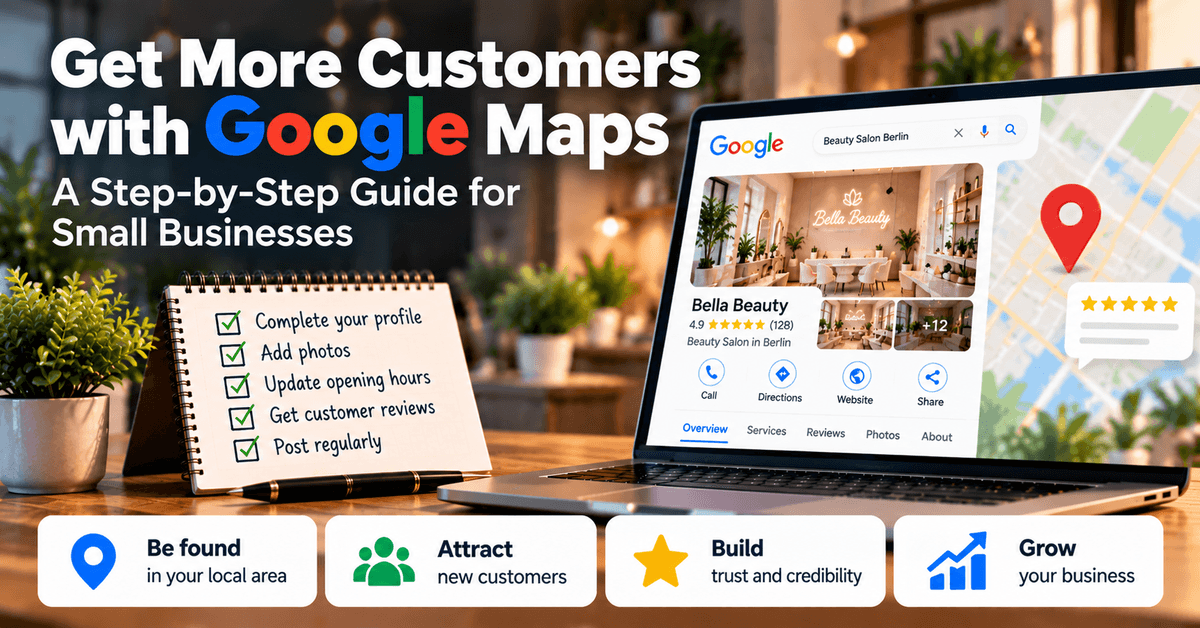
- Claim and verify your Google Business Profile where required
- Use your real business name and a relevant primary category
- Set address or service area in line with your business and Google’s rules
- Keep hours, phone number and website current
- Add accurate services and genuine photos
- Provide clear service pages and useful location information
- Test the mobile experience and contact options
- Invite honest feedback without pressure or incentives
- Respond professionally to reviews
- Review profile and website performance regularly
A four-week plan for your local visibility
Local SEO is not a one-off project, but getting started is manageable. A rhythm that fits into your day:
- Week 1: Complete the profile. Name, category, address, opening hours, services, website link and current photos. Everything must match reality.
- Week 2: Plan for reviews. Decide when and how you politely ask happy customers for a review, and reply to existing reviews factually.
- Week 3: Adjust the website. A page for each service, location and contact details clearly visible, directions described.
- Week 4: Compare details. Check directories and social profiles for identical information and note what is missing.
Also look at the case study showing how such an analysis is structured in practice.
Further reading
Frequently asked questions
How long does Local SEO take?
There is no reliable universal timeline. Competition, your starting point, profile and website all matter. Be wary of guaranteed rankings or fixed time promises.
Is a Google Business Profile enough without a website?
A profile provides details and contact options. A website offers more room to explain services, prices, processes and FAQs. Whether you need one depends on your business and customers.
Do I need a separate page for every city?
No. Create a location page only if you genuinely serve that area and can offer distinct, useful information. Pages that merely swap place names are not a sound strategy.
Can anyone guarantee my Google Maps ranking?
No. Local results depend on factors including relevance, distance and prominence. A particular position cannot be credibly guaranteed.